
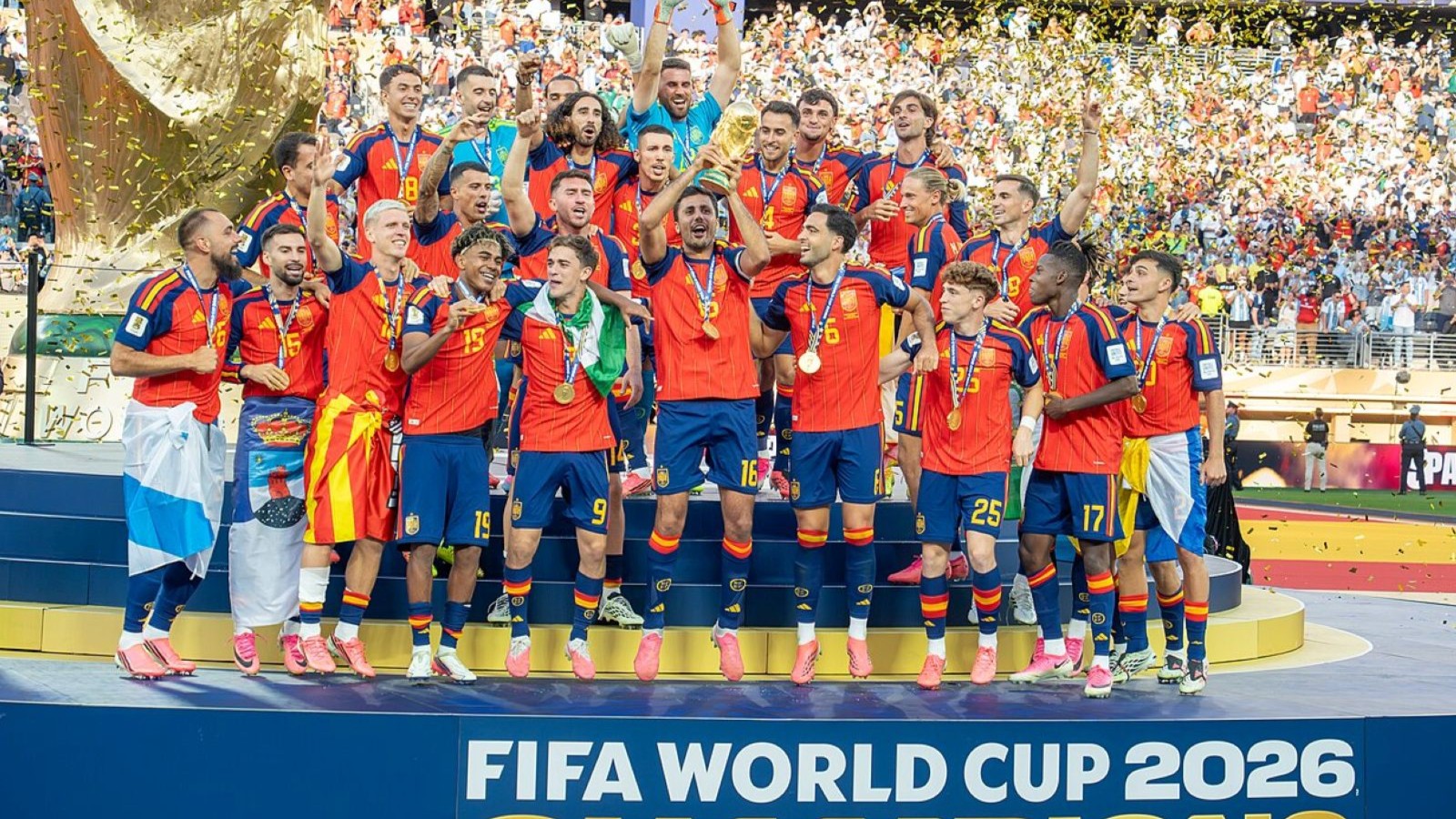
Ferran Torres ended it in extra time, Lionel Messi walked off without a repeat, and the biggest betting event in prediction-market history closed with a final worthy of its volume.
- Spain beat Argentina 1-0 in extra time Sunday at MetLife Stadium, with substitute Ferran Torres scoring in the 106th minute off a Nico Williams assist for the country’s second World Cup title.
- By kickoff, more than $1.4 billion had traded on Kalshi’s market for the final alone, with Spain drawing 59% of the action, the exclamation point on a tournament that drove over $50 billion across prediction platforms.
- The pre-match boards mostly got it right and wrong at once: regulation really did end 0-0, an outcome traders had priced at just 11%, while the goalscorer favorites, Messi at 36% and Mikel Oyarzabal at 32%, never found the net.
- The match set records on its own: Spain conceded one goal all tournament, the fewest ever for a champion, Argentina’s Emiliano Martinez made 11 saves, the most in a World Cup final, and Luis de la Fuente became the oldest coach to win it.
- Spain now holds the men’s and women’s World Cups at the same time, a first for any nation.
EAST RUTHERFORD, N.J. — The tournament that broke every betting record saved its coldest sweat for last. Spain and Argentina played 105 scoreless minutes at MetLife Stadium on Sunday, the champion of Europe grinding against the champion of the world, before substitute Ferran Torres struck from close range in the 106th minute to win Spain its second World Cup, 1-0, sixteen years after its first. Lionel Messi, 39 and almost certainly finished with World Cups, watched Argentina’s bid to become the first repeat champion since Brazil in 1962 die at the hands of a team that never let his side breathe. And on the prediction markets that turned this tournament into the biggest betting event in their history, the final went out the way the month had gone: enormous.
The Match Itself
The scoreline undersells the domination. Spain finished with 20 shots and an expected-goals figure near two; Argentina did not register a shot until the second half of extra time and finished with a fraction of one. What kept it scoreless that long was Emiliano Martinez, whose 11 saves set a record for a World Cup final, a heroic night wasted on the losing side. Argentina’s evening curdled late in regulation when Enzo Fernandez was sent off for a reckless foul on Pau Cubarsi, a second yellow in stoppage time that made him the sixth player ever dismissed in a final, the third from Argentina. Ten-man Argentina survived to extra time, and then Torres, on since the 62nd minute for Mikel Oyarzabal, met a pass from fellow substitute Nico Williams and thumped it home 39 seconds into the second extra period. “The goal belonged to 47 million people,” Torres said afterward. It was, remarkably, his first of the tournament.
The Money’s Last Word
The betting coda matched the occasion. By Sunday afternoon, Kalshi’s market on the final alone had passed $1.4 billion in volume, with Spain drawing 59% of the action, one match generating the kind of turnover that entire sports see in a month. The side markets told the sharper story. Traders in the regulation-time correct-score market, itself carrying more than $61 million, had priced a 0-0 draw at just 11%, and that unloved outcome is exactly what 90 minutes produced, paying its backers roughly nine times their stake when the whistle blew on regulation. The goalscorer board was less kind: Messi led it at 36% with Oyarzabal next at 32%, and neither scored, the match instead decided by a substitute few had priced seriously. It was a fitting close for the biggest bet in prediction-market history, a tournament that drove more than $50 billion in trading across the platforms and made a single soccer competition bigger than the election markets that built them.
The Records That Will Outlast the Party
Spain’s title came wrapped in history. The team allowed one goal in eight matches, the stingiest championship run ever, and the lone breach, in the quarterfinal against Belgium, remains the only time anyone scored on La Roja all month. Luis de la Fuente, at 65, became the oldest coach to lift the trophy, completing a Euro 2024 and World Cup double inside two years. And with the Spanish women already reigning world champions, Spain becomes the first nation to hold both World Cups at once. Argentina leaves with a different distinction, having come within one match of a repeat no one has managed in more than six decades, undone by a team that finished the tournament conceding almost nothing to anyone.
The View From California
The final also closed the strangest chapter yet in this state’s gambling story. California hosted World Cup matches it would not let anyone legally bet on, and for a month, California prediction markets served as the default sportsbook for the biggest event on earth, all of it legal at 18 under federal oversight while a $10 wager at a sportsbook remained against the law. The next men’s World Cup arrives in 2030. Between now and then sits the 2028 ballot, the tribes’ expected return to voters, which means the next time the planet’s biggest tournament kicks off, Californians may finally be betting on it the ordinary way. Until then, the record book from this one belongs to the exchanges. For everything the state allows in the meantime, our guide to California gambling covers the field.